
Home / Blog
Why is the copyeditor offered less and less?
What’s your real worth as a copyeditor? From hourly pages to high-value edits, from mechanical fixes to manuscript strategy, your journey should show growth, not just years. I’ve sat on all sides of the table; here’s an honest take on how your “worth” is measured, and how you can actually increase it.
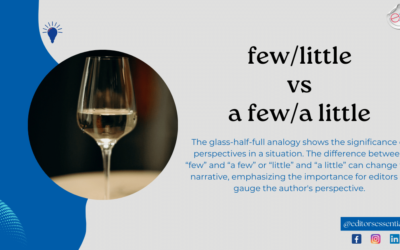
When do you use “little” and “a little” or “few” and “a few”?
The glass-half-full analogy shows the significance of perspectives in a situation. The difference between “few” and “a few” or “little” and “a little” can change a narrative, emphasizing the importance for editors to gauge the author’s perspective.

Grassroots Wisdom for the Copyeditor
Just as a bamboo shoot endures years of underground preparation before bursting into light, the copy editor needs to build a sturdy foundation of knowledge, honed by relentless practice and fueled by an insatiable love for language.
Punctuation differences between American and British English
What strikes you first when you hear the phrase “UK/US variants”? For most of us, it would be spelling variants. Have you ever come across UK/US variations with respect to punctuation? In our recent blog post, the author discusses some of the most common punctuation-level variations between UK and US English, drawing upon the CMoS and the APA style guide.
Working with editorial preferences (pet peeves)
Our latest blog post attempts to clarify some common confusions that a copyeditor may encounter while applying a few stylesheet requirements. We use the term “peeves” to refer to these requirements as a copyeditor may face editorial dilemmas in adhering to such requirements. Please read the blog post for further details and do let us know your thoughts.
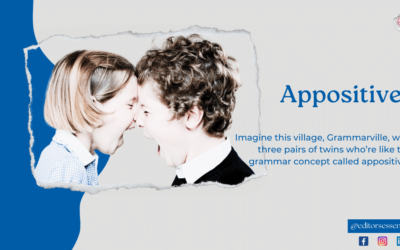
Appositives, the twins of Grammarville
Imagine this village, Grammarville, with three pairs of twins who’re like the grammar concept called appositives: the Siamese twins – super attached, just like how necessary appositives are for a sentence’s meaning; non-identical twins – not-so-tied, giving extra details like non-restrictive appositives; and mischievous identical twins ¬– context, like knowing which twin’s who, decides their use. Identifying twins needs attention – so is the case for editors!
Using boldface for formatting
Three common types of formatting followed in the publishing industry are italics, boldface, and underlines. In a previous post, we discussed the role of italics in formatting text. In this post, let’s discuss some occurrences where boldface is used. Headings As you...
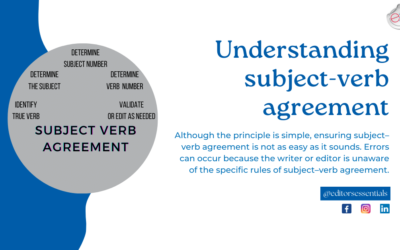
Understanding subject–verb agreement
The principle behind subject–verb agreement is simple. But ensuring subject–verb agreement is not as easy as it sounds. Errors in agreement can occur because the writer or editor is unaware of the specific rules of subject–verb agreement. Even for those who know the rule, mistakes can happen due to typos, oversight, or rushing through the editing process.
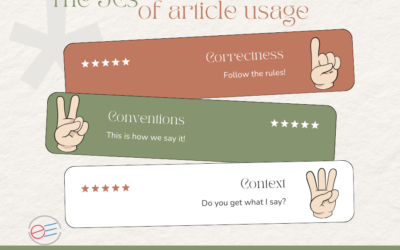
Mastering article usage in English
To approach this linguistic challenge with clarity and precision, we break down the learning process into three distinct categories: correctness, conventions, and context. These three dimensions provide unique insights into the rules that govern articles, the idiomatic expressions that shape their usage, and the dynamic contextual cues that guide their application. By understanding the different layers of article usage, one can systematically approach the learning of article usage.